
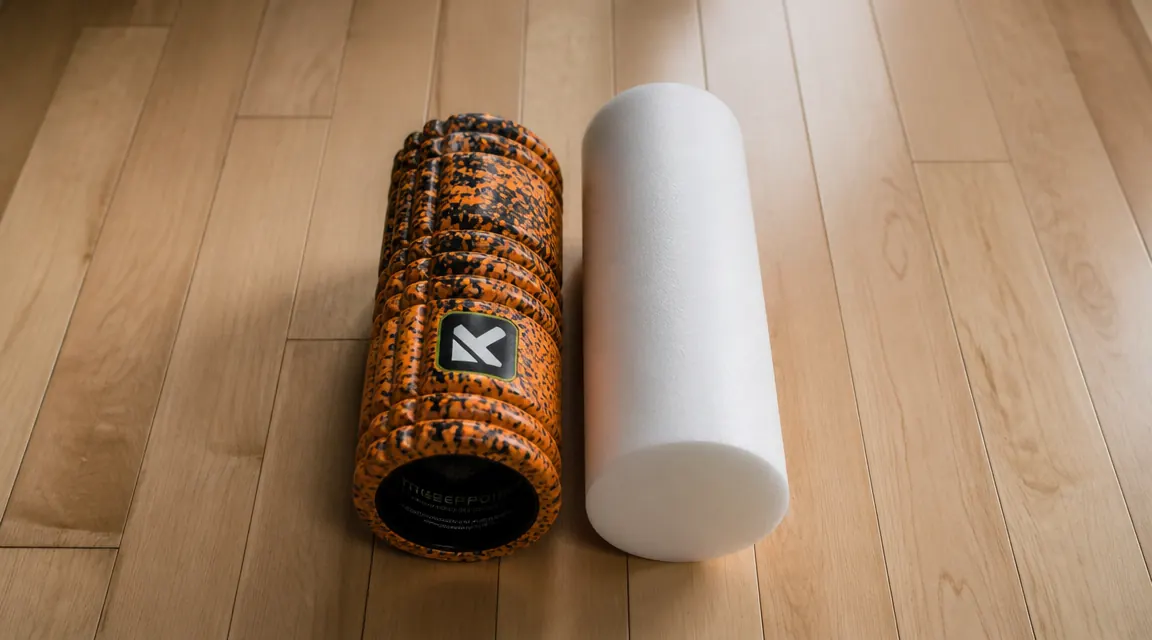
If you have been foam rolling for more than a few months, you have probably noticed something: the plain cylindrical foam roller you bought at Target is starting to feel like you are just lying on a pool noodle. You roll, you feel some pressure, but the tightness in your quads or that stubborn knot under your shoulder blade never really seems to move. That frustration is exactly what led me to test the TriggerPoint GRID 1.0 against a standard EVA foam roller over four months of consistent training.
The short answer: they are not the same tool. A plain foam roller can get the job done for general warmup and light circulation work. But if you are dealing with real tissue restriction, the kind that shows up after heavy leg days or back-to-back training sessions, the GRID's multi-density surface works in a way that flat foam simply cannot replicate. Here is the full breakdown.
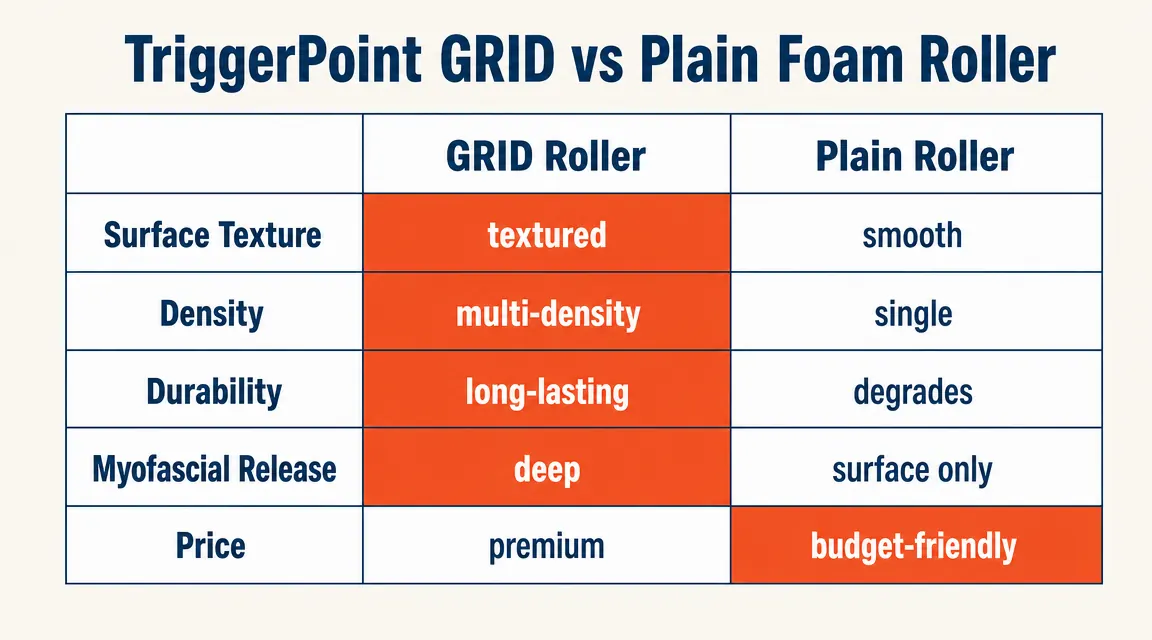
| Feature | TriggerPoint GRID 1.0 | Plain EVA Foam Roller |
|---|---|---|
| Surface Texture | Multi-density grid pattern with hollow center | Smooth solid foam cylinder |
| Firmness Options | Single medium-firm density across zones | Varies by brand , typically medium or soft |
| Core Construction | Hollow ABS plastic core, zero compression under load | Solid EVA foam , compresses and flattens over time |
| Size (standard) | 13 inches long, 5.5 inch diameter | Typically 12-18 inches, 6 inch diameter |
| Myofascial Release Depth | High , varied nodes simulate finger-tip pressure | Low to moderate , flat pressure only |
| Durability | Does not lose shape after months of daily use | Compresses and degrades within weeks to months |
| Suitable For Beginners | Yes, but intensity is higher than plain foam | Yes , gentler entry point |
| Best Use Case | Deep tissue, IT band, thoracic spine, hip flexors | Warmup, general circulation, light recovery |
| Amazon Rating | 4.7 / 5 (31,831 reviews) | Varies , typically 4.2 to 4.5 |
| Price Range | Around $40 | Typically $10 to $20 |
Where the TriggerPoint GRID Wins
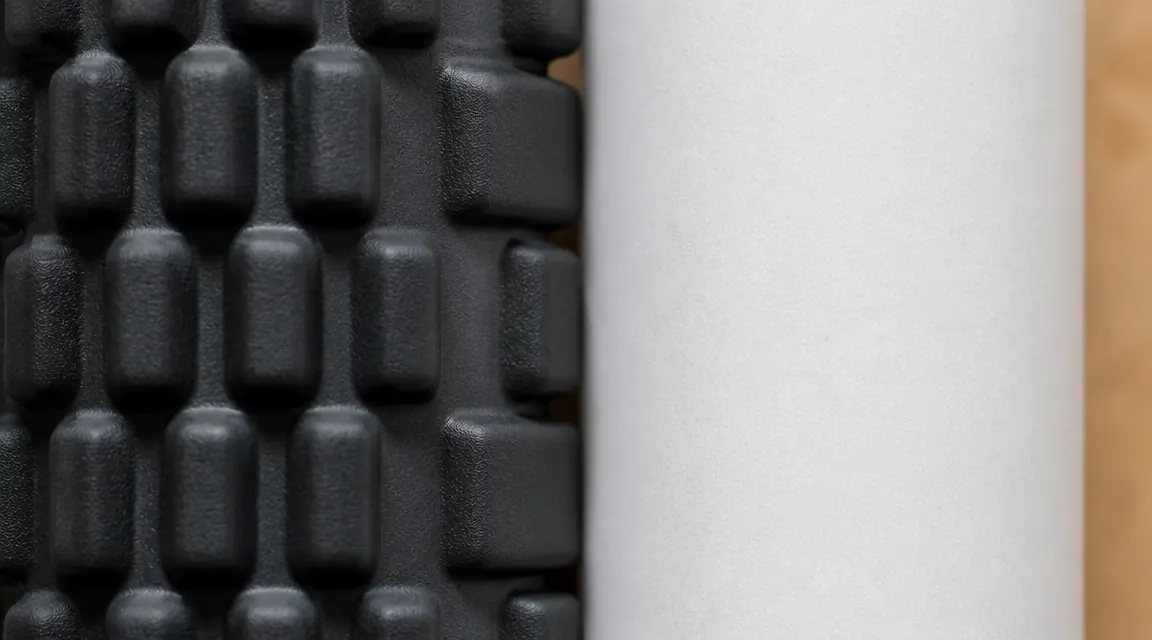
The core difference comes down to surface architecture. A plain foam roller applies uniform pressure across a flat surface. That is fine for general blood flow, but it does not replicate what a sports massage therapist actually does with their hands. They use their thumbs and knuckles to find dense spots, apply concentrated pressure, and hold. The GRID's raised nodes, flat sections, and channel grooves do a reasonable job of mimicking that varied contact. When you roll your quad over it, different zones apply different pressures simultaneously. Your nervous system responds to that variation in a way it does not respond to a flat cylinder.
Durability is the second major win. I have owned three plain foam rollers over the past few years. Every single one developed a flat side or started compressing unevenly within six to eight weeks of daily use. The GRID has a rigid hollow ABS plastic core that holds its shape regardless of how much body weight you put on it. After four months of daily use, mine looks and performs exactly the same as it did on day one. That structural integrity is not cosmetic. When a roller compresses under load, you lose all the pressure benefit you are trying to generate.
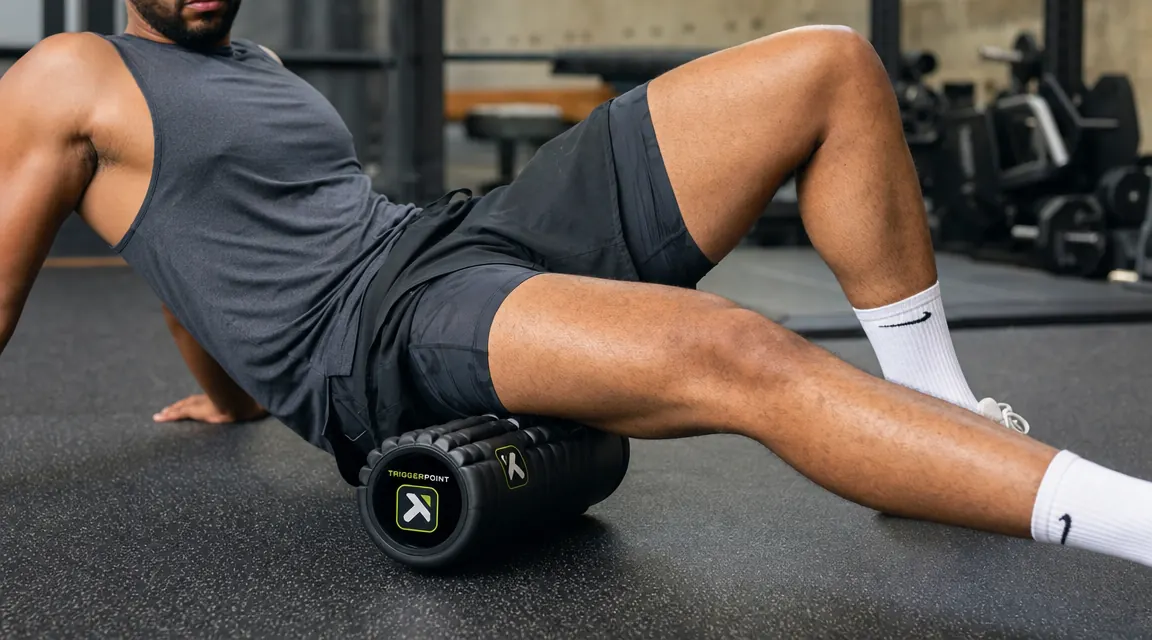
For specific problem areas, the GRID has no competition at this price point. IT band work on a plain roller often just creates surface-level discomfort without releasing the underlying tissue. Rolling the same area on the GRID, especially the channel groove running lengthwise, creates a localized pressure that actually gets into the tissue. Same story for thoracic spine mobilization and hip flexor work after long training blocks.
Where a Plain Foam Roller Still Wins
If you are brand new to foam rolling, a plain roller is a more forgiving starting point. The TriggerPoint GRID is notably more intense, especially over sensitive areas like the TFL, adductors, or upper back. Beginners who go straight to the GRID sometimes use it for two sessions, find it painful rather than productive, and give up entirely. Starting on smooth foam builds tissue tolerance and teaches you how to breathe through pressure before you graduate to a more aggressive surface.
Plain rollers also have a legitimate role in pre-workout warmup work. If you are doing a few passes over your thoracic spine and calves before lifting, a softer plain roller is adequate and less likely to cause excessive neural inhibition in the muscle tissue you are about to load. Some coaches prefer a softer roller pre-workout for this reason. The GRID is better suited for post-workout or rest-day recovery work where you are spending two to four minutes on each area.
If your plain roller has gone flat or your knots aren't moving, this is the upgrade that changes that.
The TriggerPoint GRID 1.0 is the most widely used structured foam roller in physical therapy clinics for a reason. The multi-density surface and hollow core hold up long after plain foam loses its shape.
Amazon Check Today's Price on Amazon →After four months of daily use, the GRID looks and performs exactly the same as it did on day one. Every plain roller I have owned developed a flat side within eight weeks.
The Myofascial Release Difference , What It Actually Feels Like
Myofascial release is not just a buzzword. Fascia is the connective tissue surrounding your muscles, and when it gets tight or adhered, it restricts movement and contributes to that stubborn soreness that does not resolve with stretching alone. True myofascial release requires sustained, localized pressure over a specific area, held long enough for the nervous system to signal a release. A flat foam roller can contribute to this, but the surface area contact is too broad to replicate point-specific pressure.
The GRID's raised grid nodes reduce surface contact area intentionally. Less area, same body weight, means higher pressure per point. When you find a restricted zone in your glute or lat and park your weight over a GRID node, the tissue response is noticeably different from rolling over flat foam. You feel the specific spot. You can breathe into it, hold for 30 to 60 seconds, and feel the density change. That is a functional myofascial release technique, not just rolling back and forth for 30 seconds.
Long-Term Durability , The Hidden Reason This Comparison Matters
Most people buying a foam roller are comparing sticker prices: $12 for a plain roller versus $40 for the GRID. That math changes when you factor in replacement cycles. Plain EVA foam rollers, especially the hollow-core cheaper ones, lose their structural integrity fast. A 200-pound athlete using one daily can compress it enough within six weeks that the effective density drops by half. You are essentially rolling on a slightly firmer yoga mat at that point. If you replace it twice a year, you have spent $24 on tools that degraded. The GRID has not needed replacement. The ABS plastic core does not compress under body weight, period.
There is also a usability factor with degraded foam. When a roller starts compressing unevenly, it wobbles. You lose stability mid-roll and have to engage your stabilizers just to stay on it. That is wasted energy during a recovery session, and it makes targeting specific areas much harder. The GRID stays perfectly cylindrical under load regardless of how long you have owned it.
Who Should Buy the TriggerPoint GRID
You are a good candidate for the GRID if you train more than three times a week, you have already been foam rolling for at least a month and understand the basic technique, you have specific areas of chronic tightness that plain foam has not resolved, or you want one piece of recovery equipment that will still perform the same two years from now. It is especially well-suited for runners dealing with IT band syndrome, lifters with thoracic stiffness, and anyone who spends long hours seated and carries lower back tension into their workouts.
Who Should Stick With a Plain Foam Roller
If you are just starting a foam rolling habit, the intensity of the GRID can be counterproductive. Starting with a plain roller for four to six weeks builds tissue tolerance and technique before moving to a more aggressive surface. Plain rollers also make sense if your use case is low intensity: pre-workout warmup rolling, gentle recovery between easy aerobic sessions, or general mobility work that isn't targeting deep fascial adhesions. If budget is genuinely a constraint, a plain roller used consistently is far better than no rolling at all. Do not skip recovery entirely waiting to afford the better tool.
The GRID has 31,000-plus reviews at 4.7 stars for a reason. Here is what it looks like at today's price.
TriggerPoint backs the GRID with a one-year warranty and it is the roller stocked in most physical therapy and sports performance facilities. If you have been foam rolling consistently for a few months and still have stubborn tension that isn't resolving, this is the tool worth trying.
Amazon Check Today's Price on Amazon →