
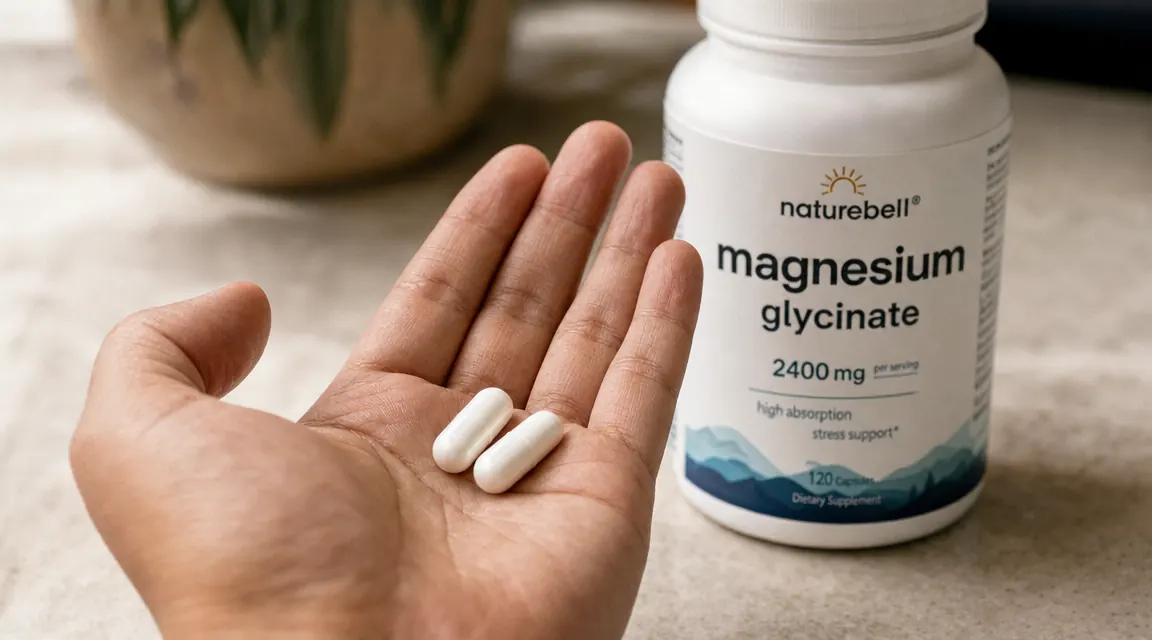
I want to save you the 45 minutes of confusion I went through the first time I bought a magnesium glycinate supplement. I stood in a supplement store staring at a label that said '500mg Magnesium Glycinate' and assumed I was getting 500mg of actual magnesium. That assumption is wrong, and it's the same assumption that leads people to either under-dose, over-dose, or conclude that 'magnesium doesn't work for me' when the real issue was never the compound at all. Naturebell Pure Magnesium Glycinate 500mg is one of the better-priced options in this category with nearly 18,000 Amazon reviews at a 4.7-star average. But there are six things about this product that the label does not spell out clearly, and knowing them before you buy will change how you use it.
I've been using magnesium glycinate for muscle recovery and sleep quality for about eight months now. I'm not a clinical researcher. I'm someone who trains five days a week, has dealt with recurring calf cramps and poor deep sleep, and has tested four different magnesium products trying to find the one that fits my routine without wrecking my stomach. Naturebell has been my daily driver for the last five of those eight months. Here's what I'd tell a training partner before they clicked 'Add to Cart.'
The Quick Verdict
A genuinely solid magnesium glycinate with 200mg elemental magnesium per 2-capsule serving, chelated for absorption, and easy on the stomach for most people. The price-per-serving is hard to beat. Two honest caveats: the capsule count math is slightly misleading on first read, and onset for sleep benefits takes longer than most people expect.
Amazon Check Today's Price →If you train hard and sleep badly, you're almost certainly low in magnesium.
Naturebell delivers 200mg of chelated elemental magnesium per serving from 240 capsules. That's a 4-month supply at the standard daily dose for under $20. Check today's price before buying elsewhere.
Amazon Check Today's Price on Amazon →Thing #1: '500mg' Is the Compound Weight, Not the Elemental Magnesium
This is the most important thing on this list and the most consistently misunderstood aspect of magnesium supplements across every brand, not just Naturebell. The '500mg' on the label refers to the weight of the magnesium glycinate compound, meaning the magnesium atom bonded to two glycine molecules. The actual elemental magnesium you get per two capsules is 200mg. That's the number that matters for physiological effect.
Two hundred milligrams of elemental magnesium per serving is actually a solid, clinically relevant dose. The Recommended Dietary Allowance for adult men is 400-420mg per day and for women 310-320mg. Most people eating a typical diet are getting somewhere in the 200-250mg range from food, so a 200mg supplement brings you close to optimal without pushing into excess. The problem is when people see '500mg' and compare it against a magnesium oxide product labeled '400mg' and conclude the oxide product is stronger. Magnesium oxide has roughly 60% elemental magnesium by weight but absorbs at less than 10% efficiency. Glycinate absorbs at 80-90%. You want the glycinate at 200mg elemental, not the oxide at 400mg nominal.

Thing #2: The 'Chelated' Claim Actually Means Something Here
A lot of supplement labels slap 'chelated' on the front without it being true in any meaningful sense. Chelation means the mineral is bonded to an organic molecule in a way that protects it through the digestive process, increasing how much actually crosses the intestinal wall. Naturebell uses a true amino acid chelate form where the magnesium is bonded to glycine. This matters for two reasons. First, absorption is higher than inorganic magnesium forms, so you get more of the dose you're paying for. Second, because the glycinate form doesn't draw as much water into the intestine as oxide or citrate does, you're far less likely to get the GI urgency that makes some magnesium products unusable.
I've tested both magnesium citrate and magnesium oxide before landing on glycinate. Citrate at full doses gave me a loose-stool effect within about two hours. Oxide was basically inert at the doses I tried, which tracks with the absorption data. Glycinate at 2 capsules nightly: nothing unusual. I've spoken to three other people in my training circle who had the same experience going from citrate or oxide to glycinate. This is not a marketing claim, it's pharmacology. The glycine bond makes a real difference if your stomach is sensitive.
Thing #3: Don't Expect Sleep Results in Week One
The sleep improvement claims around magnesium glycinate are real, but the timeline is consistently misrepresented by marketing. You'll see ads implying you'll sleep better tonight. The reality is that magnesium works by supporting your body's existing systems, not by sedating you the way melatonin does. Your magnesium levels are likely depleted from a combination of training, sweat loss, caffeine intake, and dietary gaps. Replenishing those levels is a gradual process, not a one-dose fix.
In my experience, meaningful sleep quality changes became noticeable around day 10 to 14 of consistent nightly use. The first shift I noticed was a reduction in middle-of-the-night wakefulness, followed by feeling more refreshed at the same number of hours. Muscle cramps during sleep dropped off by around the third week. If you take this for four nights, feel nothing, and return it, you're quitting too early. The people who leave one-star reviews citing 'no effect' in their first week almost always mention in the review body that they used it for less than five days. Set a 2-week minimum baseline before evaluating.
Magnesium glycinate doesn't sedate you like melatonin. It restores what training and stress depleted. The difference shows up around day 12, not day two.
Thing #4: Capsule Count Math and What 240 Actually Gets You
The bottle says 240 capsules. The serving size is 2 capsules per day. That's a 120-day supply, roughly four months, at $19.95 for the current price. That math puts the cost per day under seventeen cents and the cost per month under $5. For context, Thorne Magnesium Glycinate comes in at about $28 for 180 capsules (90 days) and Pure Encapsulations Magnesium runs around $36 for 180 capsules. You are getting meaningfully more volume for meaningfully less money with Naturebell.
The tradeoff some people point to is that the higher-end brands like Thorne and Pure Encapsulations go through third-party certification testing (NSF Certified for Sport or Informed Sport). Naturebell does not carry those certifications, though their product is manufactured in an FDA-registered facility. If you are a drug-tested competitive athlete, the certification gap matters and you should pay for Thorne or Pure Encapsulations. If you're a recreational athlete training for personal fitness, the Naturebell value proposition is nearly impossible to beat. Most of the people leaving reviews here are not competing at a tested level.
Thing #5: The Glycine Component Has Its Own Recovery Benefits
Most people buying magnesium glycinate are focused on the magnesium. They're not thinking about the glycine. But glycine is itself an amino acid with meaningful effects on sleep architecture and collagen synthesis. Research published in the journal Sleep and Biological Rhythms found that glycine supplementation at 3g before bed reduced fatigue and improved subjective sleep quality. Each serving of Naturebell Magnesium Glycinate contains roughly 400-500mg of glycine as part of the chelate. That's not the therapeutic 3g dose used in research, but it contributes to the compound effect.
For recovery specifically, glycine is a precursor to collagen, which matters for tendon and connective tissue repair. If you're dealing with joint soreness from repetitive training, the glycine component gives you a secondary benefit you weren't counting on when you bought a magnesium supplement. I don't think this is a reason to choose glycinate over other forms for collagen support specifically, but it's worth knowing that you're not just getting a mineral.
Thing #6: Dose Timing Is More Flexible Than the Label Suggests
The label says to take 2 capsules daily. It does not specify timing. Most people assume morning with other supplements. For recovery and sleep purposes, taking your magnesium glycinate 30 to 60 minutes before bed is significantly more effective than morning dosing. The magnesium supports the shift into deeper sleep stages, and the glycine component has its strongest effect when taken close to sleep onset. Morning dosing still provides the mineral benefits throughout the day, but you lose the sleep architecture benefit.
Some people split the dose, taking 1 capsule post-workout and 1 capsule before bed. If you train in the evening and regularly have trouble winding down after training, that split can help. Magnesium plays a role in downregulating the nervous system after high-intensity exercise. Post-workout dosing combined with pre-sleep dosing covers both the replenishment window and the sleep support window. The 2-capsule bottle math still works on a split schedule, so you're not losing anything by doing it this way.
What I Liked
- 200mg elemental magnesium per serving in a highly absorbable chelated form
- 240 capsules is a 4-month supply, making it one of the best cost-per-day options in this category
- Glycinate form is well-tolerated by most people who had GI issues with citrate or oxide
- The glycine component adds secondary sleep and connective tissue recovery benefits
- 4.7-star average across 18,000-plus reviews indicates consistency across a large sample
- FDA-registered manufacturing facility with solid quality controls for the price tier
Where It Falls Short
- No NSF Certified for Sport or Informed Sport third-party testing, which matters for drug-tested athletes
- The '500mg' label creates confusion around how much elemental magnesium you're actually getting
- Sleep benefits take 10-14 days of consistent use before they become noticeable, which many people don't stick through
- Capsule size is on the larger end, which some people find harder to swallow than tablets
How It Compares to What Else Is on the Market
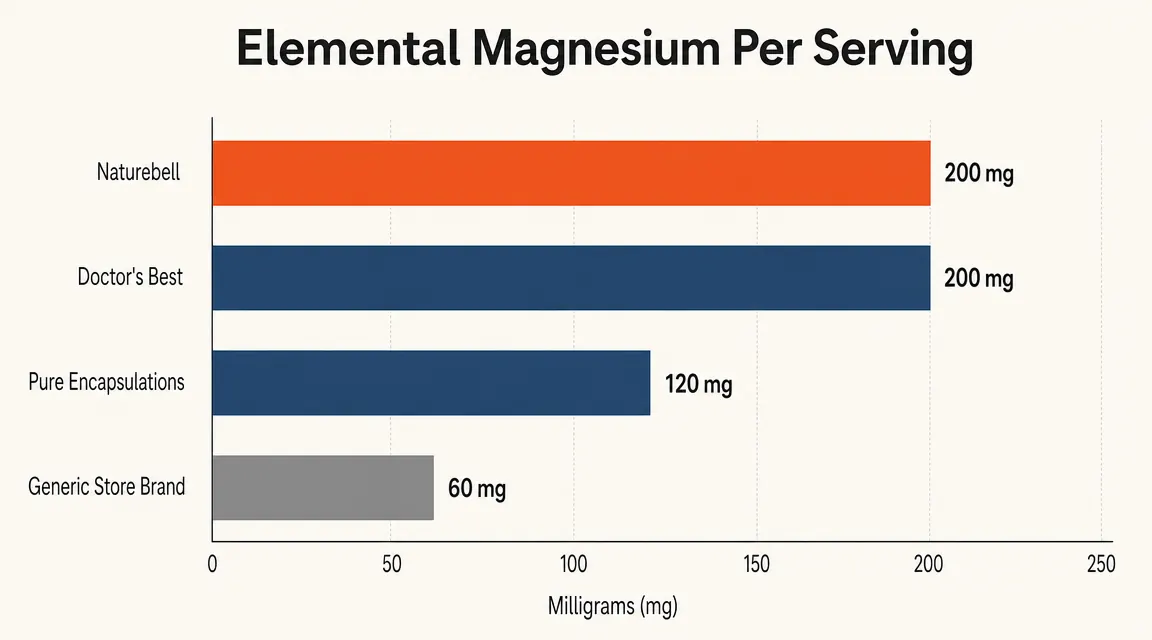
At the budget end, you have store-brand magnesium oxide products that often contain more nominal milligrams on the label but deliver far less actual magnesium due to poor bioavailability. Those are not comparable products, even if the label numbers look similar. At the mid-tier, Naturebell sits alongside Doctors Best Magnesium Glycinate (also 200mg elemental per serving) at roughly the same or slightly higher price with a similar feature set. Doctors Best has a long track record and slightly more name recognition but runs about $4-5 more for the same serving count.
At the premium tier, Thorne Magnesium Glycinate and Pure Encapsulations Magnesium both offer third-party testing that makes them appropriate for competitive or tested athletes. They cost two to three times more per month than Naturebell. If certification is not a requirement for you, that price gap is hard to justify based on the magnesium quality alone. The more relevant comparison is to magnesium citrate, which is cheaper and faster-acting for acute constipation relief but is a worse choice for sleep support due to GI side effects and the lack of glycine.
Who This Is For
Naturebell Magnesium Glycinate is the right choice if you're a recreational or competitive-but-not-drug-tested athlete who trains consistently, eats a typical Western diet, and is dealing with one or more of: poor deep sleep, middle-of-the-night wakeups, regular muscle cramping during or after training, or a general sense of not recovering well between sessions. It's also a solid first magnesium supplement if you've never tried magnesium before, because the glycinate form is forgiving on the stomach and the 240-capsule bottle gives you enough runway to actually evaluate it properly. Anyone coming from magnesium oxide or citrate who had stomach issues will likely notice an immediate tolerance improvement. Read the long-term use review for more on what the 90-day trajectory actually looks like.
Who Should Skip It
Skip Naturebell and pay for Thorne or Pure Encapsulations if you compete in a tested sport. The absence of third-party certification is a real risk in that context and not one worth taking over a $15 monthly savings. Also skip it if you have confirmed severe magnesium deficiency diagnosed by a doctor, in which case you should be following a medical dosing protocol rather than an OTC supplement. If you have kidney disease or take medications that interact with magnesium (certain antibiotics, diuretics, proton pump inhibitors), clear this with a physician before starting any magnesium supplement. Naturebell's product is not clinically different from competitors in this regard, but the caveat applies across the category.
Four months of nightly magnesium support for under $20, with the chelated form your gut can actually use.
Naturebell Magnesium Glycinate gives you 200mg of elemental magnesium per serving across 240 capsules, manufactured in an FDA-registered facility. It's the supplement I'd hand a training partner who's sleeping badly and cramping up mid-workout. Check today's price and see if there's a subscribe-and-save discount running.
Amazon Check Today's Price on Amazon →